Publications
publications by categories in reversed chronological order.
2026
- International Conf.
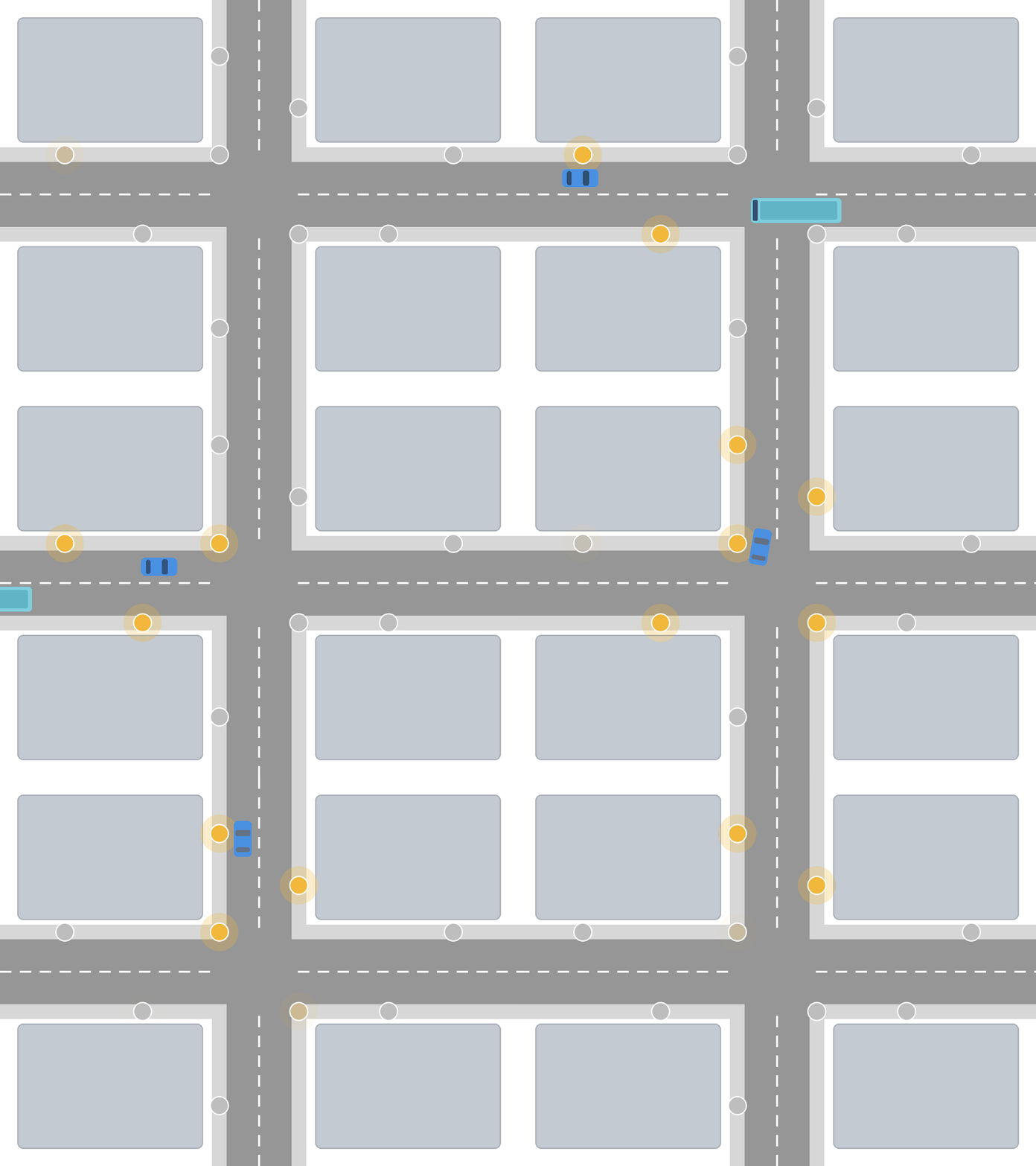 Blockage-Aware Non-stationary Dynamic Bandit for User Association in mmWave V2X NetworksWeiqi Chi and Manabu TsukadaIn IEEE Global Communications Conference (GLOBECOM2026), 2026
In millimeter-wave (mmWave) vehicular networks, dense base station (BS) deployments expand the user association (UA) decision space while dynamic blockage causes link quality fluctuations, posing critical challenges for effective mobility management. Traditional Multi-Armed Bandit (MAB) frameworks assume stationary reward distributions and fail to handle the rapid context-reward mapping shifts caused by vehicle mobility and transient blockages. To address this, we propose Blockage-Aware Non-stationary Dynamic Bandit (BAND), a fully distributed, channel state information (CSI)-free mobility management framework for mmWave vehicular networks, formulating UA as a non-stationary contextual bandit problem, enabling online adaptive optimization without requiring central coordination or offline training. BAND employs a cumulative sum-based change detection (CUSUM-CD) to dynamically narrow the active BS set, reducing exploration overhead while tracking reward distribution shifts. Proactive blockage detection suppresses transient signal degradation in the reward estimation process. Simulations demonstrate over 40% regret reduction and up to 33.1% network communication rate improvement compared with hypercube-based contextual bandit baselines, with robustness validated across varying blockage rates and network configurations.
@inproceedings{chi2026globecom, title = {Blockage-Aware Non-stationary Dynamic Bandit for User Association in mmWave V2X Networks}, author = {Chi, Weiqi and Tsukada, Manabu}, booktitle = {IEEE Global Communications Conference (GLOBECOM2026)}, year = {2026}, address = {Macau, China} } - International Conf.
 Fast-Adapting V2X Networks: A Dynamic Context Clustering Multi-Armed BanditsWeiqi Chi, Xiaoyang He, and Manabu TsukadaIn IEEE Vehicular Networking Conference (VNC2026), 2026
While contextual multi-armed bandit (CMAB) effectively addresses non-stationary reward for problems such as millimeter-wave (mmWave) Vehicle-to-Everything (V2X) user association (UA), it suffers from slow convergence when dealing with a large-scale context space. This paper proposes a Dynamic Context Clustering Semi-distributed Multi-Armed Bandit (DCC-SMAB) algorithm for the UA problem in mmWave vehicular networks that dynamically clusters vehicle positions as contexts, thereby accelerating convergence in reward estimation without requiring additional channel state information (CSI) compared to the CMAB framework with fixed context partitioning. The algorithm exhibits strong capability in identifying mmWave channel variations, enabling rapid adaptation to non-stationary communication environments for both newly arriving and existing vehicles in the network. Extensive simulations demonstrate over 61% and 76% in average regret reduction and network transmission rate improvement compared to benchmarks using Upper Confidence Bound (UCB) policy, with robustness validated across 40 trials under varying network topologies.
@inproceedings{chi2026vnc, title = {Fast-Adapting V2X Networks: A Dynamic Context Clustering Multi-Armed Bandits}, author = {Chi, Weiqi and He, Xiaoyang and Tsukada, Manabu}, booktitle = {IEEE Vehicular Networking Conference (VNC2026)}, year = {2026}, address = {Montreal, Canada} } - PosterBridging the Gap: A Realistic V2X Simulator for Cooperative Autonomous DrivingWeiqi Chi, Ryohsuke Mitsudome, Yu Asabe, and 2 more authorsIn Cooperative Interactive Vehicles (CIV) Summer School 2026, Sep 2026
Cooperative autonomous driving systems rely on Vehicle-to-Everything (V2X) communication to exchange safety-critical messages beyond onboard sensor range. Real-world channels exhibit multipath fading, distance-dependent attenuation, and obstacle shadowing, under which message delivery failures are most probable. Yet most cooperative driving algorithms assume ideal communication, creating a systematic gap between simulation and deployment. We integrate Veins into the Autoware autonomous driving stack via scenario simulator, enabling physics-based V2X channel modeling within closed-loop scenario simulation. This integration introduces a realistic wireless channel into autonomous driving simulation, exposing per-packet RSSI, SNR, and delay as ROS 2 topics for downstream evaluation.
@inproceedings{chi2026civ,
  author = {Chi, Weiqi and Mitsudome, Ryohsuke and Asabe, Yu and Qian, Bo and Tsukada, Manabu},
  title = {Bridging the Gap: A Realistic V2X Simulator for Cooperative Autonomous Driving},
  booktitle = {Cooperative Interactive Vehicles (CIV) Summer School 2026},
  year = {2026},
  month = sep,
  organization = {IEEE Intelligent Transportation Systems Society (ITSS)},
  address = {Miyazaki, Japan}
}
2025
- Poster
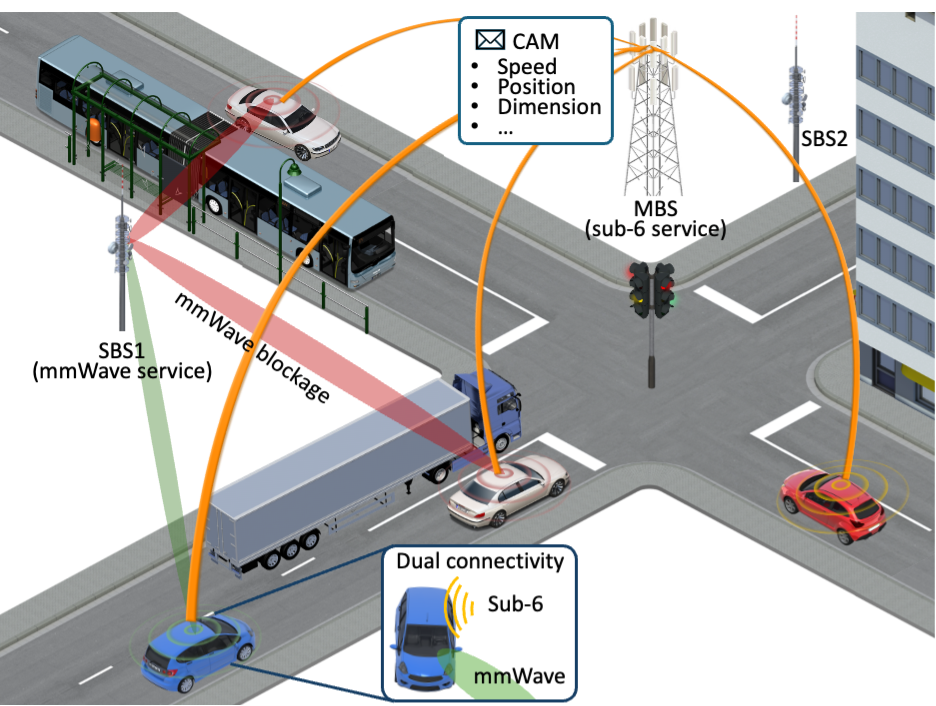 Blockage-aware Multi-armed Bandits for Proactive Handover in mmWave Vehicular NetworksWeiqi Chi and Manabu TsukadaIn Cooperative Interactive Vehicles (CIV) Summer School 2025, Sep 2025
Connected Autonomous Vehicles (CAVs) require ultra-reliable, low-latency communication for safety-critical applications, making millimeter-wave (mmWave) technology essential for achieving high data rates. However, mmWave signals suffer from severe blockage sensitivity, particularly in dynamic vehicular environments where buildings, trees, and other vehicles can cause sudden communication failures. Traditional reactive handover (HO) schemes prove inadequate for real-time CAV applications due to inherent delays and service interruptions. This paper proposes a novel blockage-aware proactive handover mechanism based on Contextual Multi-Armed Bandit (CMAB) theory for mmWave vehicular networks. The proposed approach leverages Cooperative Awareness Messages (CAM) to collect comprehensive vehicle dynamics and environmental information, enabling predictive blockage analysis through trajectory forecasting. Unlike existing reactive schemes that respond to signal degradation after blockages occur, our method anticipates future blockage events by considering vehicle kinematics and the proximity of large blocking objects. The system models each base station as an individual arm in the CMAB framework, utilizing the Upper Confidence Bound (UCB) algorithm to balance exploration and exploitation. Simulation results demonstrate improved communication reliability and reduced handover frequency compared to conventional reactive approaches, making it suitable for safety-critical autonomous driving applications.
@inproceedings{chi2025civ, author = {Chi, Weiqi and Tsukada, Manabu}, title = {Blockage-aware Multi-armed Bandits for Proactive Handover in mmWave Vehicular Networks}, booktitle = {Cooperative Interactive Vehicles (CIV) Summer School 2025}, year = {2025}, organization = {IEEE Intelligent Transportation Systems Society (ITSS)}, abspdf = {chi2025civ_abs.pdf}, address = {Geneva, Switzerland}, } - Domestic Conf.
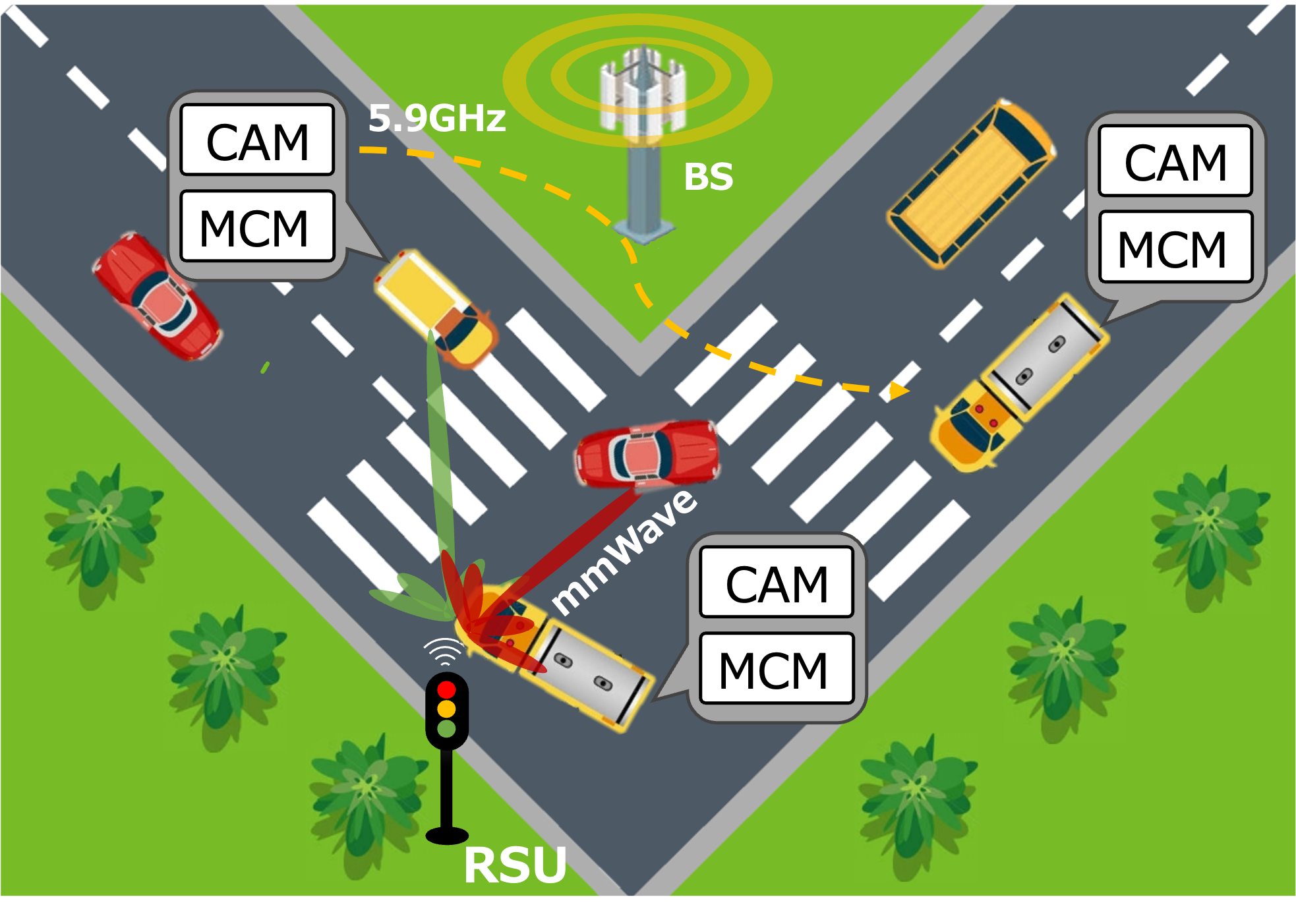 ミリ波帯における遮蔽対応型V2I通信と解決策について偉奇 池, 仁 中里, 友規 村上, and 1 more authorIn 電子情報通信学会技術(IEICE)研究報告, Mar 2025
In the Intelligent Transportation System (ITS), vehicle-to-everything (V2X) communication serves as a critical functional enabler, offering solutions for traffic management, road safety, and emergency response. With the increasing demand for real-time data sharing in advanced ITS applications, millimeter-wave (mmWave) communication has emerged as a promising technology capable of delivering high data rates and low-latency communication. However, severe link quality degradation caused by blockages remains a significant challenge in the mmWave band, particularly in high-mobility environments and on roads with heavy traffic volumes. This paper proposes a blockage-aware traffic coordination system. By utilizing Maneuver Coordination Messages (MCMs), the system enables roadside units (RSUs) to predict future blockages and take proactive measures to avoid them. Traffic dynamics are modeled and analyzed using the Simulation of Urban Mobility (SUMO) simulator, integrated with MATLAB. A variety of vehicle types is simulated under a suburban vehicle-to-infrastructure (V2I) communication scenario. Additionally, system performance is evaluated by considering excessive losses due to diffraction effects caused by vehicles.
@inproceedings{chi2025rcs,
  title = {ミリ波帯における遮蔽対応型V2I通信と解決策について},
  title_english = {Blockage-aware V2I Communication and Solutions in mmWave Band},
  author = {池, 偉奇 and 中里, 仁 and 村上, 友規 and 塚田, 学},
  author_english = {Chi, Weiqi and Nakazato, Jin and Murakami, Tomoki and Tsukada, Manabu},
  booktitle = {電子情報通信学会技術(IEICE)研究報告},
  booktitle_english = {IEICE Technical Report},
  volume = {124},
  number = {396},
  pages = {7--12},
  year = {2025},
  month = mar,
  organization = {電子情報通信学会},
  address = {京都工芸繊維大学},
  issn = {0913-5685},
  url = {https://jglobal.jst.go.jp/detail?JGLOBAL_ID=202502253471001607}
}
2024
- International Conf.
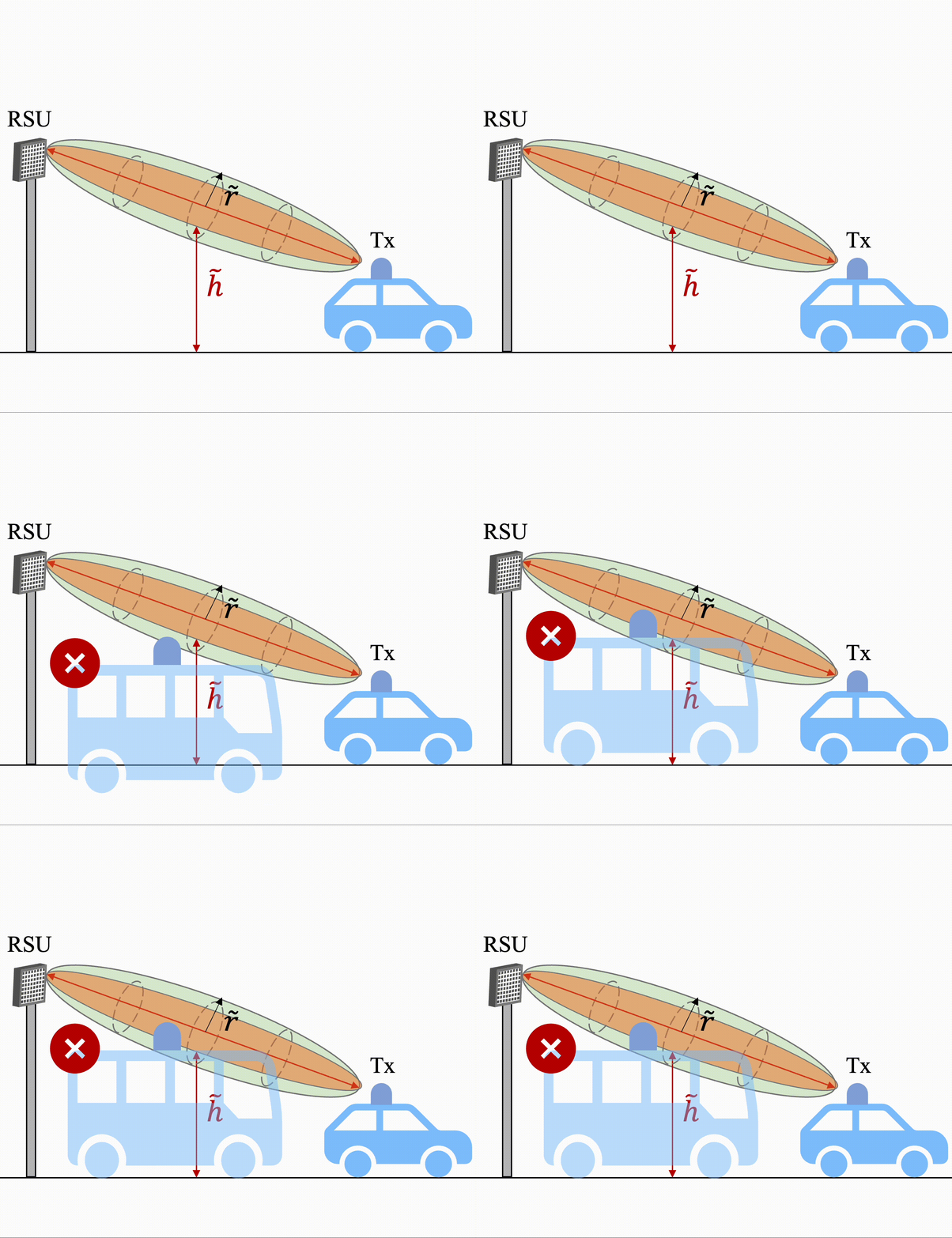 V2I Blockage Modeling and Performance Evaluation for Connected Autonomous VehicleWeiqi Chi, Jin Nakazato, Tomoki Murakami, and 1 more authorIn IEEE Vehicular Technology Conference (VTC2024-Spring), Mar 2024
Young Researcher’s Encouragement Award
The burgeoning Intelligent Transportation System (ITS) spurs global technological advancements, notably in innovative community development through vehicle-to-everything (V2X) communication. This study focuses on the high data rates and low latency offered by a millimeter-wave (mmWave) enabled vehicular network while addressing the significant challenge of link quality degradation due to blockages, exacerbated by the mmWave band’s small wavelength in high mobility and traffic conditions. We propose an RSU-assisted ITS system tailored for multi-lane, straight-road scenarios, effectively identifying blockage status for vehicles. Combining Simulation of Urban Mobility (SUMO) and MATLAB, this blockage-aware scheme lays the groundwork for future ITS enhancements. The research also delves into the effects of various frequency bands, vehicle types, and communication ranges, offering a holistic system performance analysis.
@inproceedings{chi2024v2i,
  title = {V2I Blockage Modeling and Performance Evaluation for Connected Autonomous Vehicle},
  author = {Chi, Weiqi and Nakazato, Jin and Murakami, Tomoki and Tsukada, Manabu},
  booktitle = {IEEE Vehicular Technology Conference (VTC2024-Spring)},
  year = {2024},
}
2022
- Domestic Conf.
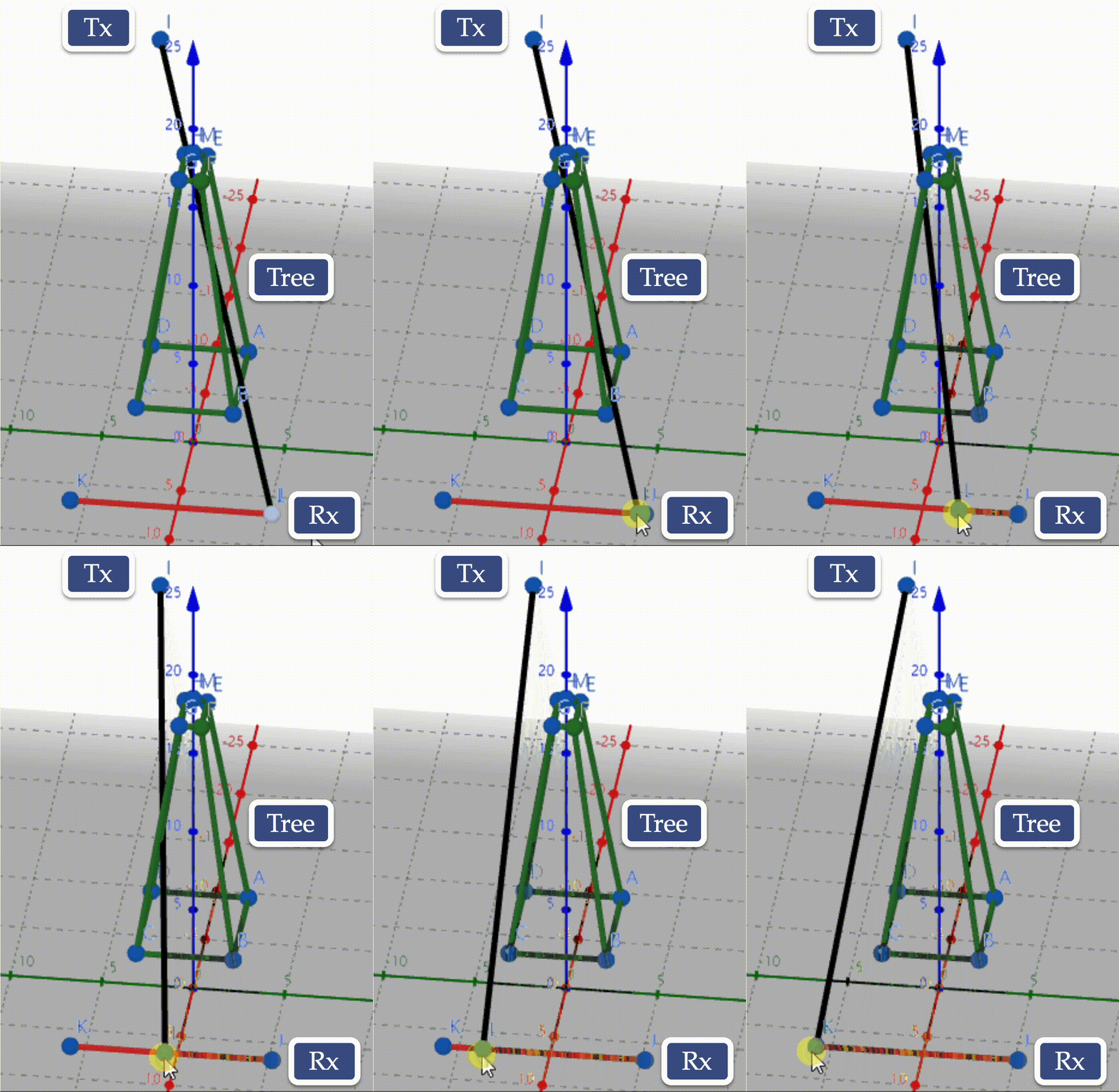 Outdoor Measurement of Millimeter-Wave Propagating Through Vegetation at 28GHz BandWeiqi Chi, N. Keerativoranan, and J. TakadaIn 13th Multidisciplinary International Student Workshop (MISW) Conference, Aug 2022Oral Presentation, Chairperson
Millimeter wave (mmWave) 5G New Radio offers high data rates but suffers from blockage due to small wavelengths. Vegetation causes significant attenuation in mmWave networks, yet limited measurements exist. This work investigates reference signal received power (RSRP) attenuation caused by ginkgo tree trunks and branches during the leaf-off period.
@inproceedings{chi2022misw, title = {Outdoor Measurement of Millimeter-Wave Propagating Through Vegetation at 28GHz Band}, author = {Chi, Weiqi and Keerativoranan, N. and Takada, J.}, booktitle = {13th Multidisciplinary International Student Workshop (MISW) Conference}, year = {2022}, month = aug, address = {Tokyo, Japan}, note = {Oral Presentation, Chairperson} } - Domestic Conf.
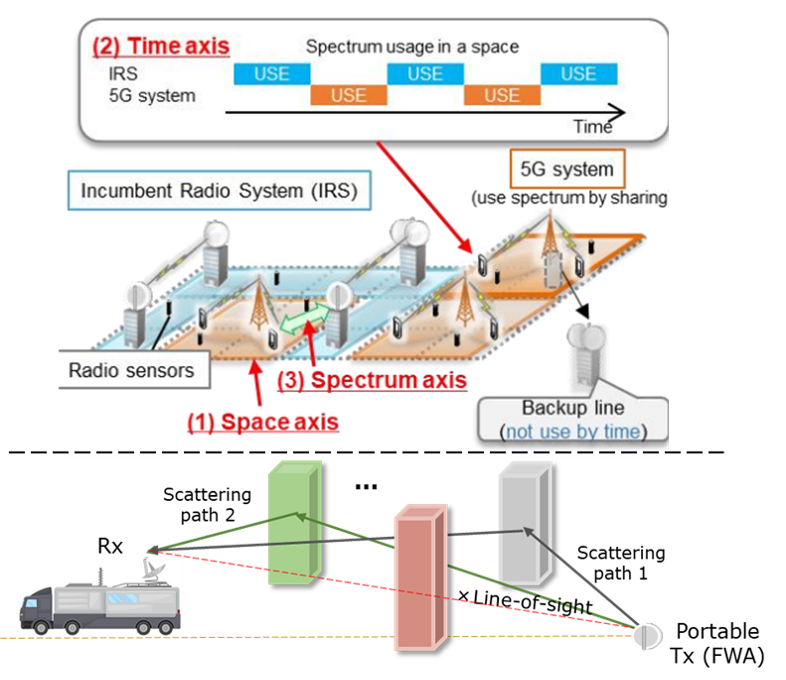 Outdoor mmWave Band Tx Localization Using Scattering Path under Spectrum Sharing ScenarioWeiqi Chi, N. Keerativoranan, and J. TakadaIn 12th Multidisciplinary International Student Workshop (MISW) Conference, Aug 2022Oral Presentation
Best Oral Presenter
Spectrum resources are artificially scarce due to static legacy regulations that prevent intensive sharing. This work focuses on spatial spectrum sharing in the millimeter wave (mmWave) band for Fixed Wireless Access (FWA) in Japan. A key challenge is localizing unregistered portable transmitters that are not in the spectrum sharing database. In mmWave bands, highly directive propagation and urban blockages make empirical localization models impractical. We propose leveraging environment maps and angular information from both line-of-sight (LOS) and non-line-of-sight (NLOS) propagation paths, including scattering along streets and corners, to improve localization performance in urban NLOS scenarios where LOS paths are not guaranteed.
@inproceedings{chi2021misw,
  title = {Outdoor mmWave Band Tx Localization Using Scattering Path under Spectrum Sharing Scenario},
  author = {Chi, Weiqi and Keerativoranan, N. and Takada, J.},
  booktitle = {12th Multidisciplinary International Student Workshop (MISW) Conference},
  year = {2022},
  month = aug,
  address = {Tokyo, Japan},
  note = {Oral Presentation}
}
2021
- International Conf.
 Outdoor mmWave Band Tx Localization Using Scattering Path under Spectrum Sharing ScenarioWeiqi Chi, N. Keerativoranan, and J. TakadaIn 13th AOTULE (Asia-Oceania Top University League on Engineering) Student Conference, Nov 2021Oral Presentation
@inproceedings{chi2021aotule, title = {Outdoor mmWave Band Tx Localization Using Scattering Path under Spectrum Sharing Scenario}, author = {Chi, Weiqi and Keerativoranan, N. and Takada, J.}, booktitle = {13th AOTULE (Asia-Oceania Top University League on Engineering) Student Conference}, year = {2021}, month = nov, address = {Daejeon, Korea}, note = {Oral Presentation} }